• Link to X
  • Link to Facebook
  • Link to Youtube
  • Link to Mail
UCLA Center for Neighborhood Knowledge
  • Home
  • About
    • Team
    • Contact
  • News
  • Maps
    • California COVID-19 Maps
      • CA COVID-19 Medical Vulnerability
      • CA COVID-19 Owner Vulnerability
      • CA COVID-19 Renter Vulnerability
    • Los Angeles COVID-19 Maps
      • Los Angeles Vulnerability
      • Los Angeles County COVID-19 Medical Vulnerability
    • CA Transportation Disparities Mapping Tool
    • South LA Decides: Children Data and Mapping Portal
    • Lens: HIV Prevalence and COVID-19 Vulnerabilities
      • Lens 1.0: HIV Prevalence and COVID-19 Vulnerabilities
      • Lens 2.0: HIV Prevalence and COVID-19 Vulnerabilities
    • Bulldozing Asian Communities: Freeway Construction and Urban Renewal in Stockton
  • Research
    • Current Projects
    • COVID-19
      • COVID Publications
    • Publications
  • Immigration
  • LA Wildfires
  • Menu Menu
Blog - Latest News

Black and Brown Neighborhoods Lack Resources to Shelter-in-Place During COVID19

May 20, 2020/0 Comments/in Publications/by Silvia R. González

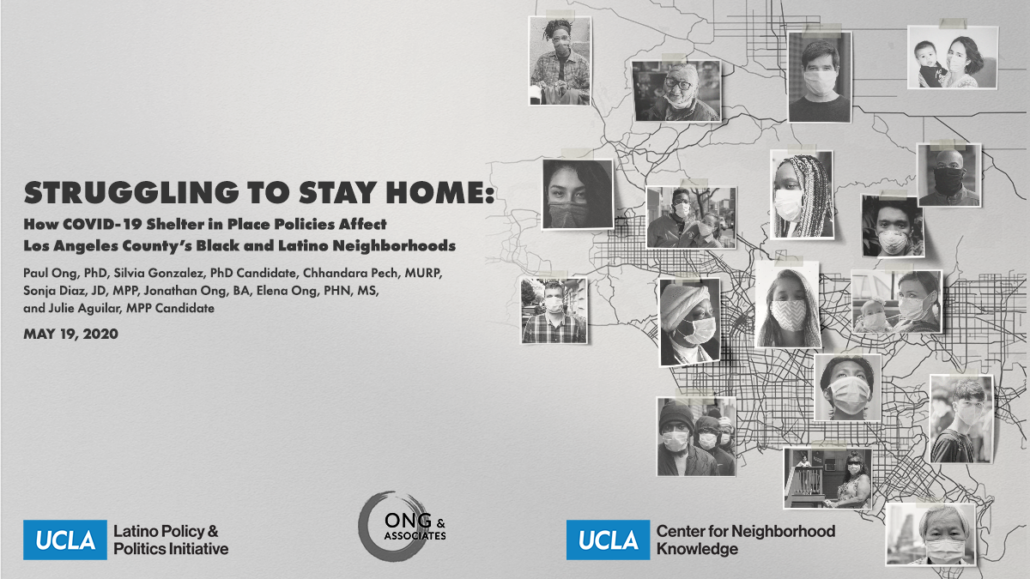
Our new research brief released today in partnership with UCLA Latino Policy and Politics Initiative (UCLA LPPI) shows that over 40 percent of Latino and Black residents in Los Angeles live in neighborhoods that lack basic necessities, making it challenging and unsafe for residents during the shelter-in-place restrictions during the COVID-19 pandemic.

The most burdened neighborhoods are concentrated in South Los Angeles, in contrast to the least burdened neighborhoods that are concentrated in the city’s more affluent Westside coastal communities. 

The difference in neighborhood resources means that residents in high-burden areas face greater risk at infection if they have to leave their neighborhood to access basic needs such as groceries and healthcare services, the report says. The lack of safe outdoor recreational space raises mental health concerns. Furthermore, the most burdened neighborhoods also have a high concentration of renters and households without cars, creating further economic stress and increased risk of infection through the reliance of public transportation.

The research builds on previous efforts to measure the burden of sheltering in place with the UCLA Institute on Inequality and Democracy and the public interest firm, Ong & Associates.

Download>> Struggling to Stay Home: How COVID19 Shelter in Place Policies Affect Los Angeles County’s Balck and Latino Neighborhoods

Tags: COVID Publication, covid19, inequality, los angeles, neighborhoods
Share this entry
  • Share on Facebook
  • Share on X
  • Share on LinkedIn
  • Share by Mail
https://knowledge.luskin.ucla.edu/wp-content/uploads/2020/05/facebook.png 675 1200 Silvia R. González https://knowledge.luskin.ucla.edu/wp-content/uploads/2020/04/Uxd_Blk_CNK_Luskin_E.png Silvia R. González2020-05-20 21:50:212020-11-10 00:54:57Black and Brown Neighborhoods Lack Resources to Shelter-in-Place During COVID19
You might also like
David Ryder / 2021 Getty Images Asian American Businesses: The Impacts of Anti-Asian Racism, 2021
https://www.flickr.com/photos/29456235@N04/ L.A.’s COVID-19 Economic Crisis: Renter Vulnerability Index
Evaluating 2020 Census Data for L.A. County by Comparing Parcel-Based Housing Counts
Inequality and COVID-19 Food Insecurity
Webinar – Confronting COVID-19: The Toll of the Virus on LA’s Most Vulnerable Communities
Systemic Racial Inequality and the COVID-19 Homeowner Crisis
Restaurant owners of color struggle to stay afloat during the pandemic
Launch of Movement Hub Website with AAPI Civic Engagement Fund
0 replies

Leave a Reply

Want to join the discussion?
Feel free to contribute!

Leave a Reply Cancel reply

Your email address will not be published. Required fields are marked *

Pages

  • About
  • Bulldozing Asian Communities: Freeway Construction and Urban Renewal in Stockton
  • CA COVID-19 Medical Vulnerability
  • CA COVID-19 Owner Vulnerability
  • CA COVID-19 Renter Vulnerability
  • CA Transportation Disparities Mapping Tool
  • California Maps
  • Contact
  • COVID Publications
  • COVID-19 Equity Research Initiative
  • Current Projects
  • Director Paul M. Ong
  • Home
  • Immigration
  • LA Wildfires
  • Los Angeles County COVID-19 Medical Vulnerability
  • Los Angeles Vulnerability
  • Maps
  • News
  • Publications
  • Sitemap
  • South LA Decides: Children Data and Mapping Portal
  • Team
  • The Lens 2.0: HIV Prevalence and COVID-19 Vulnerabilities

Categories

  • Events
  • LA Wildfires Data Briefs
  • News
  • Ong
  • Publications
  • Uncategorized

Archive

  • April 2026
  • September 2025
  • July 2025
  • March 2025
  • February 2025
  • January 2025
  • September 2024
  • December 2023
  • November 2023
  • September 2023
  • February 2023
  • May 2022
  • April 2022
  • March 2022
  • February 2022
  • January 2022
  • December 2021
  • November 2021
  • October 2021
  • September 2021
  • August 2021
  • July 2021
  • June 2021
  • May 2021
  • April 2021
  • March 2021
  • February 2021
  • January 2021
  • December 2020
  • November 2020
  • October 2020
  • September 2020
  • August 2020
  • July 2020
  • June 2020
  • May 2020
  • April 2020
  • March 2020
  • December 2019
  • October 2019
  • June 2019
  • May 2019
  • February 2019
  • July 2018
  • June 2018
  • March 2018
  • February 2018
© Copyright - UCLA Center for Neighborhood Knowledge - Login - Enfold WordPress Theme by Kriesi
Link to: US Census Response Rates on American Indian Reservations in the 2020 Census and in the 2010 Census Link to: US Census Response Rates on American Indian Reservations in the 2020 Census and in the 2010 Census US Census Response Rates on American Indian Reservations in the 2020 Census... Link to: New Interactive COVID-19 Impacts Maps and Data Link to: New Interactive COVID-19 Impacts Maps and Data New Interactive COVID-19 Impacts Maps and Data
Scroll to top Scroll to top Scroll to top