• Link to X
  • Link to Facebook
  • Link to Youtube
  • Link to Mail
UCLA Center for Neighborhood Knowledge
  • Home
  • About
    • Team
    • Contact
  • News
  • Maps
    • California COVID-19 Maps
      • CA COVID-19 Medical Vulnerability
      • CA COVID-19 Owner Vulnerability
      • CA COVID-19 Renter Vulnerability
    • Los Angeles COVID-19 Maps
      • Los Angeles Vulnerability
      • Los Angeles County COVID-19 Medical Vulnerability
    • CA Transportation Disparities Mapping Tool
    • South LA Decides: Children Data and Mapping Portal
    • Lens: HIV Prevalence and COVID-19 Vulnerabilities
      • Lens 1.0: HIV Prevalence and COVID-19 Vulnerabilities
      • Lens 2.0: HIV Prevalence and COVID-19 Vulnerabilities
    • Bulldozing Asian Communities: Freeway Construction and Urban Renewal in Stockton
  • Research
    • Current Projects
    • COVID-19
      • COVID Publications
    • Publications
  • Immigration
  • LA Wildfires
  • Menu Menu
Blog - Latest News

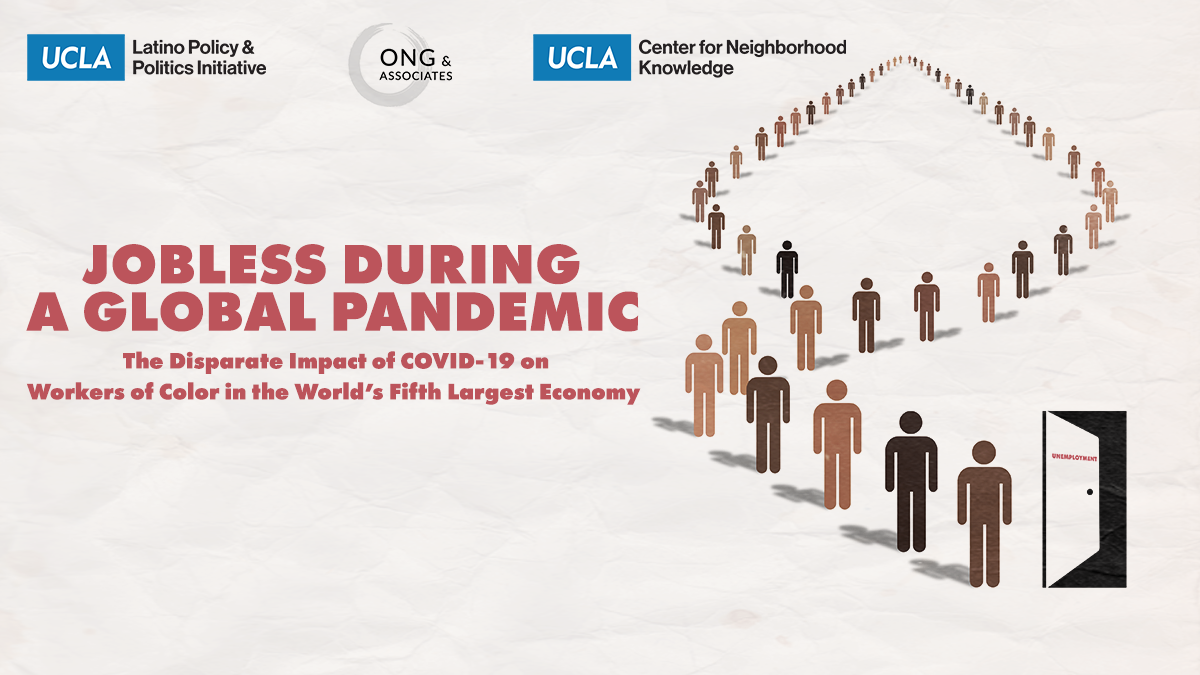
Jobless During a Global Pandemic

June 11, 2020/1 Comment/in Publications/by Silvia R. González
State’s Black, Latino Workers Less Likely to Be Covered by Unemployment Insurance Amid COVID-19UCLA report recommends that California extend economic recovery funding to all workers
June 11, 2020

By Eliza Moreno

An analysis of unemployment in California at the height of the COVID-19 crisis shows that as many as 22% of Blacks and 26% of Latinos were jobless, compared to 17% of both white and Asian workers.

The new report, by the UCLA Latino Policy and Politics Initiative and the UCLA Center for Neighborhood Knowledge, is based not only on data from the filing of unemployment insurance claims, but also on labor statistics and U.S. Census data.

The paper examines the totality of the pandemic’s effect through mid-April on the California labor market by including estimates of the numbers of undocumented workers and so-called discouraged workers — people who want to be employed but are not actively engaged due to factors like job shortages, discrimination or a lack of requisite skills.

With state officials discussing a recovery package that will include adjustments to unemployment support, the UCLA report highlights the importance of including assistance for all types of workers, not just those who have filed unemployment claims. According to the study, roughly 1 million additional workers need assistance, and between 350,000 to 500,000 of them are undocumented.

“Many of the people facing devastating economic losses are in the shadows, and this report puts a figure to that loss so that policymakers understand where to focus their support as we move toward recovery,” said Sonja Diaz, founding director of the Latino Policy and Politics Initiative.

The report’s other key findings include:

  • More than 3 million workers in California have lost their jobs as a result of the COVID-19 pandemic, more than any other state.
  • More than 900,000 Californians have lost their jobs due to layoffs and have stopped looking for work as a result of the pandemic.
  • Over a quarter of Californians experiencing job loss were ineligible for unemployment insurance.
  • One-third of Californians who are receiving unemployment insurance are Latino.
  • Latinos are 59% of Californians who are ineligible for unemployment insurance.

“Economic recovery can only be achieved by understanding who is hurting the most from the pandemic-induced recession,” said Chhandara Pech, a researcher at the Center for Neighborhood Knowledge and co-author of the paper. “Our report underscores that in the nation’s richest state, those at the bottom of the economic ladder need help the most.”

The report recommends that state policymakers expand the eligibility requirements for unemployment insurance, including for workers who may need to take time off to care for sick relatives. It also urges expansion of support to include health care and rental assistance, including for undocumented Californians.

The research brief is the fourth in a series of research papers examining the economic impact of the COVID-19 pandemic on neighborhoods in Los Angeles County. Previous papers in the series found that Asian-American and Latino neighborhoods in Los Angeles County were most vulnerable due to the pandemic’s impact on the retail and service sectors, Latino neighborhoods were less likely to receive the individual rebate under the CARES Act, and many Blacks and Latinos live in neighborhoods that lack basic necessities during the county’s safer-at-home order.

The research is being conducted with assistance from Ong & Associates, an economic and policy analysis consulting firm specializing in public interest issues. Ong & Associates provided services pro bono for the study. Its founder is Paul Ong, director of the Center for Neighborhood Knowledge, which is housed in the UCLA Luskin School of Public Affairs.

Download the full report >> Jobless During a Global Pandemic

Tags: california, COVID Publication, covid19, inequality, unemployment
Share this entry
  • Share on Facebook
  • Share on X
  • Share on LinkedIn
  • Share by Mail
https://knowledge.luskin.ucla.edu/wp-content/uploads/2020/06/CNK-unemployment-twitter.png 675 1200 Silvia R. González https://knowledge.luskin.ucla.edu/wp-content/uploads/2020/04/Uxd_Blk_CNK_Luskin_E.png Silvia R. González2020-06-11 10:16:332020-11-10 00:54:30Jobless During a Global Pandemic
You might also like
President Biden announced changes Monday to the Paycheck Protection Program aimed at helping smaller businesses owned by women and people of color to qualify for federal loans due to the economic impact that has been caused by the COVID-19 pandemic. Alex Wong/Getty Images New PPP plan aims to level playing field for smallest businesses
COVID-19 Vulnerability Indicators: California Data for Equity in Public Health Decision-Making
The report estimates that 233,000 Asian American small businesses closed from February to April, representing a decline of 28% over the two-month period. Photo by Rich Legg / iStock Report shows impact of COVID-19 on Asian American labor force
COVID-19 and the Digital Divide in Virtual Learning
Mario Ramírez Garcia, 10, listen as his teacher addresses the class during distance learning in the bedroom he shares with his sister on April 23, 2021. According to their father, the internet connection at their Oakland home cuts out about twice a week, which is especially frustrating to the kids when they are taking tests. Photo by Anne Wernikoff, CalMatters Analysis shows why millions of California students lack broadband
CNK Research Finds Census Inequity in L.A. County
Parts of L.A. Hit Hardest by COVID-19 Also Among Those Where Census Response Lags 2010
Assessing Vulnerability Indicators and Race/Ethnicity
1 reply

Trackbacks & Pingbacks

  1. One year later: 15 ways life has changed since the onset of the COVID pandemic - Kanarys says:
    March 9, 2021 at 10:58 am

    […] often face; conversations about wages, immigration reform, childcare, affordable credit, unemployment insurance, police and bail reform, even union protections. It’s time to make sure essential workers stay […]

    Reply

Leave a Reply

Want to join the discussion?
Feel free to contribute!

Leave a Reply Cancel reply

Your email address will not be published. Required fields are marked *

Pages

  • About
  • Bulldozing Asian Communities: Freeway Construction and Urban Renewal in Stockton
  • CA COVID-19 Medical Vulnerability
  • CA COVID-19 Owner Vulnerability
  • CA COVID-19 Renter Vulnerability
  • CA Transportation Disparities Mapping Tool
  • California Maps
  • Contact
  • COVID Publications
  • COVID-19 Equity Research Initiative
  • Current Projects
  • Director Paul M. Ong
  • Home
  • Immigration
  • LA Wildfires
  • Los Angeles County COVID-19 Medical Vulnerability
  • Los Angeles Vulnerability
  • Maps
  • News
  • Publications
  • Sitemap
  • South LA Decides: Children Data and Mapping Portal
  • Team
  • The Lens 2.0: HIV Prevalence and COVID-19 Vulnerabilities

Categories

  • Events
  • LA Wildfires Data Briefs
  • News
  • Ong
  • Publications
  • Uncategorized

Archive

  • April 2026
  • September 2025
  • July 2025
  • March 2025
  • February 2025
  • January 2025
  • September 2024
  • December 2023
  • November 2023
  • September 2023
  • February 2023
  • May 2022
  • April 2022
  • March 2022
  • February 2022
  • January 2022
  • December 2021
  • November 2021
  • October 2021
  • September 2021
  • August 2021
  • July 2021
  • June 2021
  • May 2021
  • April 2021
  • March 2021
  • February 2021
  • January 2021
  • December 2020
  • November 2020
  • October 2020
  • September 2020
  • August 2020
  • July 2020
  • June 2020
  • May 2020
  • April 2020
  • March 2020
  • December 2019
  • October 2019
  • June 2019
  • May 2019
  • February 2019
  • July 2018
  • June 2018
  • March 2018
  • February 2018
© Copyright - UCLA Center for Neighborhood Knowledge - Login - Enfold WordPress Theme by Kriesi
Link to: New Interactive COVID-19 Impacts Maps and Data Link to: New Interactive COVID-19 Impacts Maps and Data New Interactive COVID-19 Impacts Maps and Data Link to: Persistent Shortfall and Racial/Class Disparities 2020 Census Self-Response Rate Link to: Persistent Shortfall and Racial/Class Disparities 2020 Census Self-Response Rate Persistent Shortfall and Racial/Class Disparities 2020 Census Self-Response...
Scroll to top Scroll to top Scroll to top