• Link to X
  • Link to Facebook
  • Link to Youtube
  • Link to Mail
UCLA Center for Neighborhood Knowledge
  • Home
  • About
    • Team
    • Contact
  • News
  • Maps
    • California COVID-19 Maps
      • CA COVID-19 Medical Vulnerability
      • CA COVID-19 Owner Vulnerability
      • CA COVID-19 Renter Vulnerability
    • Los Angeles COVID-19 Maps
      • Los Angeles Vulnerability
      • Los Angeles County COVID-19 Medical Vulnerability
    • CA Transportation Disparities Mapping Tool
    • South LA Decides: Children Data and Mapping Portal
    • Lens: HIV Prevalence and COVID-19 Vulnerabilities
      • Lens 1.0: HIV Prevalence and COVID-19 Vulnerabilities
      • Lens 2.0: HIV Prevalence and COVID-19 Vulnerabilities
    • Bulldozing Asian Communities: Freeway Construction and Urban Renewal in Stockton
  • Research
    • Current Projects
    • COVID-19
      • COVID Publications
    • Publications
  • Immigration
  • LA Wildfires
  • Menu Menu
Blog - Latest News

Persistent Shortfall and Racial/Class Disparities 2020 Census Self-Response Rate

June 14, 2020/0 Comments/in Publications/by Silvia R. González

Because of COVID-19 and other factors, the United States faces the unprecedented challenge of completing the 2020 census enumeration, the once in a decade effort to count every American for critically important political, economic and social reasons. The Census Bureau is winding down the self-response phase of the census, our new brief assesses what progress has been made. The analysis is primarily based on examining the 2010 and 2020 response rates for census tracts, which is a proxy for neighborhoods.

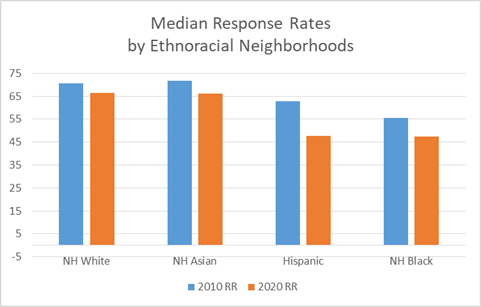
There are two key outcomes: The temporal (across time) change in the overall average response rates and the temporal change in the range (high to low) of response rates. The change in overall response rates, or the total shortfall, is the difference in census response rates between the two decades. The second outcome measures the change from 2010 to 2020 in the spread between tracts with high response rates and tracts with low response rates.

Key Findings:

  • On June 1, the nation was approximately six percentage points behind where the nation was in 2010, which is better than the over 12 percentage point shortfall during late April. Despite the progress, it is unlikely that the overall gap could be closed completely. Every state is experiencing an increased response gap relative to 2010. Equally troubling is a larger spread in the response rates among some neighborhoods. This increase is evident within most states, although there are large variations.
  • More troubling is that poor and minority communities are systematically and disproportionately affected by the problems with the self-response rates. These neighborhoods experienced lower response rates in 2010 than more advantaged neighborhoods, and the gap widened in 2020.

Policy Implications:

The problems with the 2020 Census create enormous challenges to having a complete and unbiased enumeration. In turn, this threatens and undermines the goal of having fair political representation and just resource allocation. Among the many adjustments that are required to complete the census is adopting a new rapid response monitoring and assessment paradigm, similar to what has emerged to study the spread of COVID-19.

Download full brief>> Persistent Shortfall and Racial/Class Disparities 2020 Census Self-Response Rate
Tags: census2020, COVID Publication, covid19, inequality, nation
Share this entry
  • Share on Facebook
  • Share on X
  • Share on LinkedIn
  • Share by Mail
https://knowledge.luskin.ucla.edu/wp-content/uploads/2020/06/racial-disparities.png 307 481 Silvia R. González https://knowledge.luskin.ucla.edu/wp-content/uploads/2020/04/Uxd_Blk_CNK_Luskin_E.png Silvia R. González2020-06-14 10:02:162020-11-10 00:54:07Persistent Shortfall and Racial/Class Disparities 2020 Census Self-Response Rate

You might also like
Ong on Increasing Asian American Representation in Biden Administration
COVID-19 and LA’s At-Risk Workers
Crisis to Impact: Reflecting on a Decade of Housing Counseling Services in Asian American and Pacific Islander Communities
Systemic Racial Inequality and the COVID-19 Renter Crisis
Inequality and COVID-19 Job Displacement
Parts of L.A. Hit Hardest by COVID-19 Also Among Those Where Census Response Lags 2010
Assessing Vulnerability Indicators and Race/Ethnicity
Systemic Racial Inequality and the COVID-19 Homeowner Crisis
0 replies

Leave a Reply

Want to join the discussion?
Feel free to contribute!

Leave a Reply Cancel reply

Your email address will not be published. Required fields are marked *

Pages

  • About
  • Bulldozing Asian Communities: Freeway Construction and Urban Renewal in Stockton
  • CA COVID-19 Medical Vulnerability
  • CA COVID-19 Owner Vulnerability
  • CA COVID-19 Renter Vulnerability
  • CA Transportation Disparities Mapping Tool
  • California Maps
  • Contact
  • COVID Publications
  • COVID-19 Equity Research Initiative
  • Current Projects
  • Director Paul M. Ong
  • Home
  • Immigration
  • LA Wildfires
  • Los Angeles County COVID-19 Medical Vulnerability
  • Los Angeles Vulnerability
  • Maps
  • News
  • Publications
  • Sitemap
  • South LA Decides: Children Data and Mapping Portal
  • Team
  • The Lens 2.0: HIV Prevalence and COVID-19 Vulnerabilities

Categories

  • Events
  • LA Wildfires Data Briefs
  • News
  • Ong
  • Publications
  • Uncategorized

Archive

  • April 2026
  • September 2025
  • July 2025
  • March 2025
  • February 2025
  • January 2025
  • September 2024
  • December 2023
  • November 2023
  • September 2023
  • February 2023
  • May 2022
  • April 2022
  • March 2022
  • February 2022
  • January 2022
  • December 2021
  • November 2021
  • October 2021
  • September 2021
  • August 2021
  • July 2021
  • June 2021
  • May 2021
  • April 2021
  • March 2021
  • February 2021
  • January 2021
  • December 2020
  • November 2020
  • October 2020
  • September 2020
  • August 2020
  • July 2020
  • June 2020
  • May 2020
  • April 2020
  • March 2020
  • December 2019
  • October 2019
  • June 2019
  • May 2019
  • February 2019
  • July 2018
  • June 2018
  • March 2018
  • February 2018
© Copyright - UCLA Center for Neighborhood Knowledge - Login - Enfold WordPress Theme by Kriesi
Link to: Jobless During a Global Pandemic Link to: Jobless During a Global Pandemic Jobless During a Global Pandemic Link to: Webinar – Confronting COVID-19: The Toll of the Virus on LA’s Most Vulnerable Communities Link to: Webinar – Confronting COVID-19: The Toll of the Virus on LA’s Most Vulnerable Communities Webinar – Confronting COVID-19: The Toll of the Virus on LA’s Most Vulnerable...
Scroll to top Scroll to top Scroll to top