• Link to X
  • Link to Facebook
  • Link to Youtube
  • Link to Mail
UCLA Center for Neighborhood Knowledge
  • Home
  • About
    • Team
    • Contact
  • News
  • Maps
    • California COVID-19 Maps
      • CA COVID-19 Medical Vulnerability
      • CA COVID-19 Owner Vulnerability
      • CA COVID-19 Renter Vulnerability
    • Los Angeles COVID-19 Maps
      • Los Angeles Vulnerability
      • Los Angeles County COVID-19 Medical Vulnerability
    • CA Transportation Disparities Mapping Tool
    • South LA Decides: Children Data and Mapping Portal
    • Lens: HIV Prevalence and COVID-19 Vulnerabilities
      • Lens 1.0: HIV Prevalence and COVID-19 Vulnerabilities
      • Lens 2.0: HIV Prevalence and COVID-19 Vulnerabilities
    • Bulldozing Asian Communities: Freeway Construction and Urban Renewal in Stockton
  • Research
    • Current Projects
    • COVID-19
      • COVID Publications
    • Publications
  • Immigration
  • LA Wildfires
  • Menu Menu
Blog - Latest News

At-Risk Workers of Covid-19 by Neighborhood in the San Francisco Bay Area

May 14, 2020/0 Comments/in Publications/by Silvia R. González

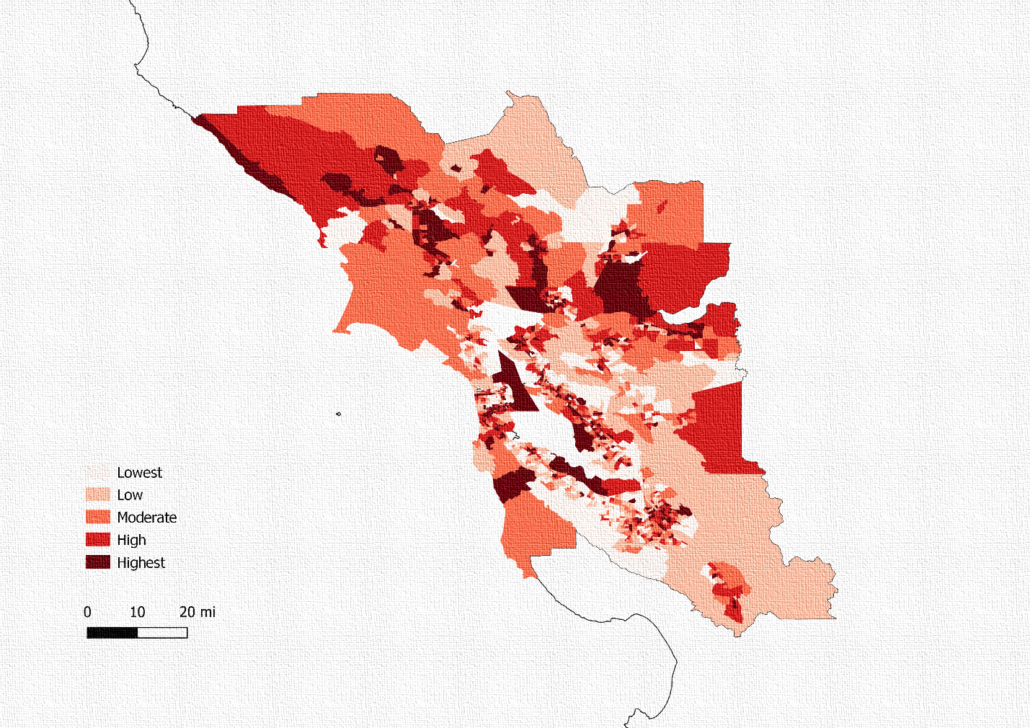
As many other urban areas, the San Francisco Bay Area faces unprecedented social and economic disruptions due to the spread of COVID-19. Our new research brief with Professor Don Mar and Ong & Associates examines the location, racial-ethnic composition, immigrant composition, and socioeconomic circumstances of workers in two sectors highly impacted by COVID-19 related closures: service workers in the hospitality industry and sales workers in the retail industries.

Workers in these sectors are more likely to earn low-wages, live in poverty, or identify as people of color – particularly Latinos/Latinas who are the ethnic majority group in the service and hospitality sectors.  51 % of predominantly Latino neighborhoods are characterized as “highest at-risk” with another 32% of Latino neighborhoods characterized as “high risk.”  In addition, 48% of the poorest neighborhoods in the Bay Areas have the “highest-at- risk” share of workers.

With the historic levels of unemployment claims being file in the California, now is the time to consider near-and long-term policies that strengthen and support the economic basis of vulnerable communities.  This brief offers a series of recommendations that fill the gap between proposed legislation at the federal level and the needs of vulnerable communities who are the most susceptible to the economic consequences of COVID-19.  Understanding these workers’ social and economic realities leads to better targeted policy responses that protect vulnerable communities, including undocumented workers who are not eligible for most federal COVID-19 relief programs.  Policymakers and elected officials have the opportunity to safeguard California’s status as the world’s 5th largest economy by providing tailored relief to vulnerable Californians and closing the gaps in care that exist under current federal stimulus programs.

Download >> At-Risk Workers of Covid-19 by Neighborhood in the San Francisco Bay Area

See our brief series on COVID-19 here

Tags: bay area, COVID Publication, covid19, inequality, neighborhoods
Share this entry
  • Share on Facebook
  • Share on X
  • Share on LinkedIn
  • Share by Mail
https://knowledge.luskin.ucla.edu/wp-content/uploads/2020/05/bay-area-vulnerable.png 1010 1429 Silvia R. González https://knowledge.luskin.ucla.edu/wp-content/uploads/2020/04/Uxd_Blk_CNK_Luskin_E.png Silvia R. González2020-05-14 15:26:292020-11-10 00:57:19At-Risk Workers of Covid-19 by Neighborhood in the San Francisco Bay Area
You might also like
Despite improved access, digital divide persists for minority, low-income students
Latino city in Arizona grew, but census says it shrank
UCLA Center for Neighborhood Knowledge Develops Online Anti-Racism Hub Focusing on Asian Americans
US Census Response Rates on American Indian Reservations in the 2020 Census and in the 2010 Census
‘Overlooked’: Asian American Jobless Rate Surges But Few Take Notice
Left Behind During a Global Pandemic
Impact of coronavirus pandemic on U.S. Census 2020
Evaluating 2020 Census Data for L.A. County by Comparing Parcel-Based Housing Counts
0 replies

Leave a Reply

Want to join the discussion?
Feel free to contribute!

Leave a Reply Cancel reply

Your email address will not be published. Required fields are marked *

Pages

  • About
  • Bulldozing Asian Communities: Freeway Construction and Urban Renewal in Stockton
  • CA COVID-19 Medical Vulnerability
  • CA COVID-19 Owner Vulnerability
  • CA COVID-19 Renter Vulnerability
  • CA Transportation Disparities Mapping Tool
  • California Maps
  • Contact
  • COVID Publications
  • COVID-19 Equity Research Initiative
  • Current Projects
  • Director Paul M. Ong
  • Home
  • Immigration
  • LA Wildfires
  • Los Angeles County COVID-19 Medical Vulnerability
  • Los Angeles Vulnerability
  • Maps
  • News
  • Publications
  • Sitemap
  • South LA Decides: Children Data and Mapping Portal
  • Team
  • The Lens 2.0: HIV Prevalence and COVID-19 Vulnerabilities

Categories

  • Events
  • LA Wildfires Data Briefs
  • News
  • Ong
  • Publications
  • Uncategorized

Archive

  • April 2026
  • September 2025
  • July 2025
  • March 2025
  • February 2025
  • January 2025
  • September 2024
  • December 2023
  • November 2023
  • September 2023
  • February 2023
  • May 2022
  • April 2022
  • March 2022
  • February 2022
  • January 2022
  • December 2021
  • November 2021
  • October 2021
  • September 2021
  • August 2021
  • July 2021
  • June 2021
  • May 2021
  • April 2021
  • March 2021
  • February 2021
  • January 2021
  • December 2020
  • November 2020
  • October 2020
  • September 2020
  • August 2020
  • July 2020
  • June 2020
  • May 2020
  • April 2020
  • March 2020
  • December 2019
  • October 2019
  • June 2019
  • May 2019
  • February 2019
  • July 2018
  • June 2018
  • March 2018
  • February 2018
© Copyright - UCLA Center for Neighborhood Knowledge - Login - Enfold WordPress Theme by Kriesi
Link to: Parts of L.A. Hit Hardest by COVID-19 Also Among Those Where Census Response Lags 2010 Link to: Parts of L.A. Hit Hardest by COVID-19 Also Among Those Where Census Response Lags 2010 Parts of L.A. Hit Hardest by COVID-19 Also Among Those Where Census Response... Link to: US Census Response Rates on American Indian Reservations in the 2020 Census and in the 2010 Census Link to: US Census Response Rates on American Indian Reservations in the 2020 Census and in the 2010 Census US Census Response Rates on American Indian Reservations in the 2020 Census...
Scroll to top Scroll to top Scroll to top